
Active Warrants in Pawnee County
Pawnee County publishes no single portal where every active warrant can be searched. The most visible public channel is the Pawnee County Sheriff's Most Wanted page. Treat it as a curated subset. It is not a complete roster of District Court, traffic, municipal, family, sealed, or federal warrants. The sheriff's own warning says the information may not be current and should not be used alone for legal action. For a live case question, search a known District Court case in OSCN or ODCR. Call the Pawnee County Court Clerk. Contact the city court named on a municipal citation, and ask the sheriff whether county law enforcement has service or custody information. In the end, no office here can substitute for the issuing court's status decision on a Pawnee County warrant.
Pawnee's Most Wanted Page Is a Curated Subset
The Pawnee County Most Wanted program is built for browsing, not for a full warrant lookup. Its search field lets you scan the roster, and each card carries labels for race, sex, eye color, hair color, aliases, approximate bond amount, last known location, and the wanted-for offense. What the page leaves off matters just as much. There is no total result count, no complete warrant number, no issuing-court filter, no update timestamp, and no export. Nothing on it promises that every active warrant in Pawnee County appears there.
Treat a card as a lead, not an answer. It cannot tell you whether a court order is still current. Confirm with the sheriff at (918) 762-2565, then check with the issuing court. Names, photos, aliases, and other card details should never be copied into a public roster.
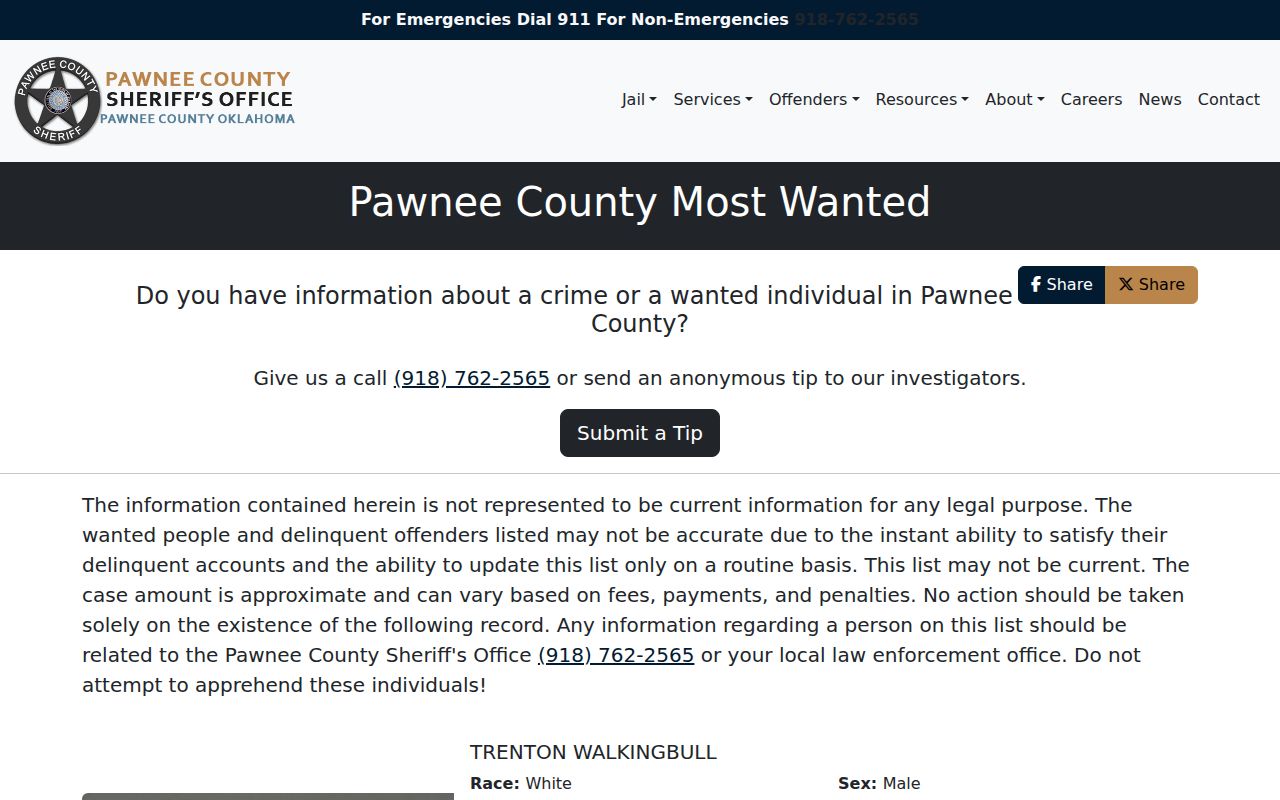
The image shows the public program interface and warning context while omitting individual cards.
How the Pawnee County Active Warrant List Works
The Pawnee County list runs on no published schedule. No nightly, weekly, or monthly refresh is promised. The program itself says updates are routine and the data may not be current, which matters right after a payment, a court appearance, an arrest, a recall, or service of the warrant. A stale card and a missing card lead to the same wrong conclusion from opposite directions.
OSCN and ODCR keep their own timing. A docket event can land there before the sheriff page ever changes, and a city matter may never show up in the county program at all. Note the date you checked. Then call the office that controls the warrant and ask.
The Pawnee Sheriff’s “Not Current” Warning
The Pawnee County sheriff posts its own caution on the Most Wanted page. The information is not represented as current for legal purposes. The bond amount shown is approximate and may shift with fees, payments, and penalties. Readers are directed to the sheriff or local law enforcement, told that no action should rest on the record alone, and warned not to attempt an apprehension themselves.
Read the warning: A Most Wanted result is a public-information lead, not a court order, service confirmation, or clearance certificate.
That warning should shape how anyone uses the page. An official office can confirm a known matter in Pawnee County. But approaching a person, sharing a roster, or sending money off the back of an online card are all moves a reader should refuse.
What an Active Pawnee Warrant Shows
A sheriff card is thin next to the case file. The Pawnee County warrant record itself may carry more. Read the case number, court, judge, offense or FTA reason, bond or release condition, and any later status event as one picture. Addresses and full birth dates do not belong in public copy.
| Case number | OSCN uses case formats such as CF-2014-1; no Pawnee warrant-number format was confirmed. |
|---|---|
| Issuing court | Shows where a recall, new date, payment plan, or bond question belongs. |
| Reason | May be probable cause, missed appearance, traffic FTA, or failure to satisfy an order. |
| Service status | May be held by the sheriff or city police, apart from a docket event. |
| Current action | Look for active, served, recalled, quashed, returned, or new-appearance language. |
OSCN and ODCR Versus an Active-Warrant Record
OSCN and ODCR are court-record systems, not warrant databases. OSCN lets you search by county or court and case number, and its docket tools can surface event entries. ODCR goes further, with fields for party, court group, case type, full case number, filed date, and activity date. Neither is a statewide active-warrant record. A docket event can be worth raising with the clerk in a Pawnee County courthouse, but it does not replace the official file. A city citation, a sealed case, a juvenile file, or a brand-new order may sit outside the view. Start with OSCN and ODCR, then verify what you find.
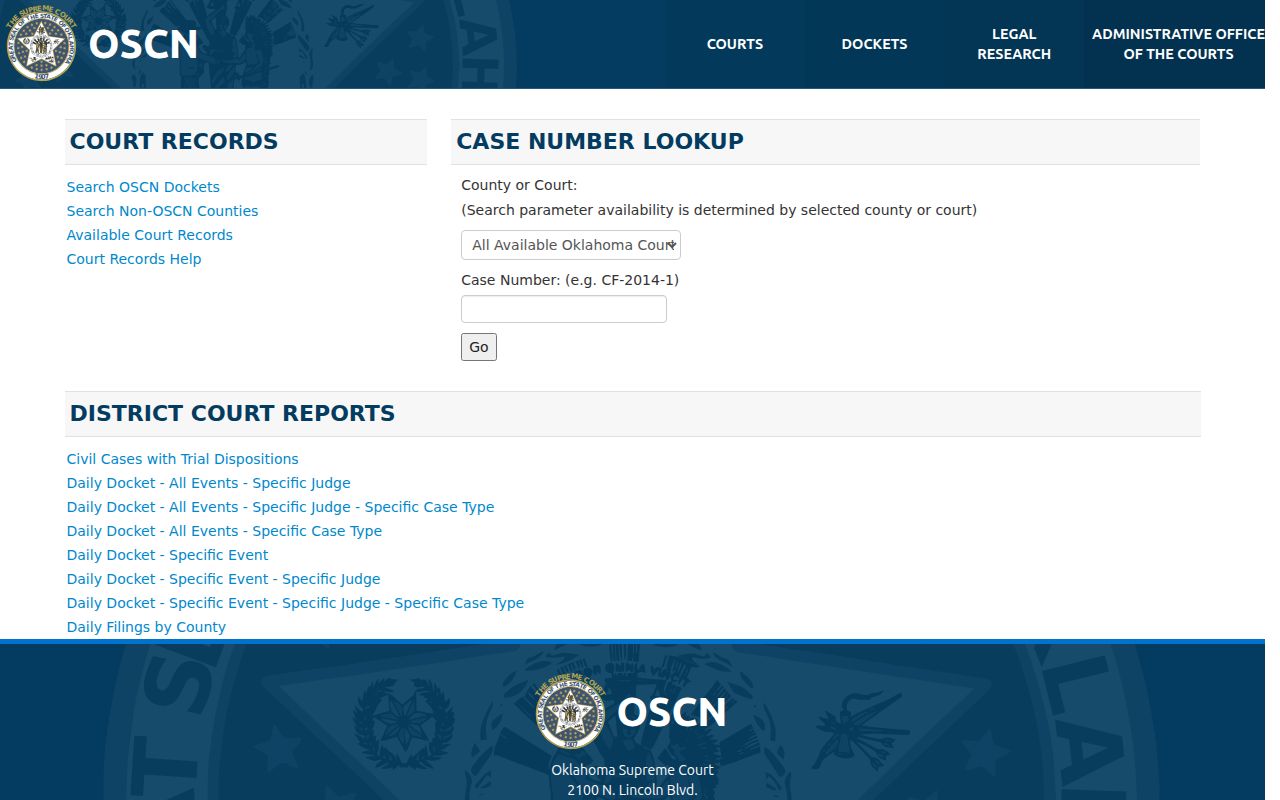
The case-search image is a court-record route, not a list of active warrants.
Why a City FTA May Miss the Sheriff Page
Pawnee Municipal Court and Cleveland Municipal Court each run their own city process. Miss an appearance there, or fail to satisfy an order, and the city court's published rules can produce an arrest warrant. That citation may never feed the sheriff's curated Most Wanted program, so the paper itself is your routing document. Jennings, Ralston, and Westport have no official municipal portal online, which makes it even more so.
A District Court traffic FTA works differently in Pawnee County. It can create a court event plus a separate Service Oklahoma suspension route. Still, a driving-privilege status tells you nothing about whether a warrant is active. Do not lean on it.
Confirming an Active Warrant at 500 Harrison
District Court records at Pawnee County run through the Court Clerk's OSCN and ODCR route, and it pays to ask about the current docket event while you are there. The clerk's page lists the public records the office holds, a one-to-two-week estimate for a records request, $1 per page, and $0.50 to certify. Those figures cover the clerk's records route only. A general sheriff warrant search is a different door. For service or custody questions, call the sheriff at (918) 762-2565 and ask which court issued the process, whether the office has received it, and where a current order sits on the record. The sheriff page makes no promise of a complete count, a response deadline, or a walk-in cure, so the issuing court remains the place that can confirm a Pawnee County warrant.

The Pawnee County sheriff's home page lists its public contact channels but posts no full warrant-search link.
Most Wanted Lists and Warrant Roundups
Pawnee County runs no amnesty or roundup program right now. No safe-surrender event or special hotline exists. A historic reference to another municipality is not a county program, so treat any roundup claim with care. If Pawnee County announces one later, check the sponsor, the eligible court type, the dates, the payment method, any judge requirement, and proof of clearance with the issuing office. Until then, the ordinary routes work fine. Use the court, the sheriff, an attorney, bond, or Service Oklahoma. Reduced fees are never promised by an ordinary active warrant.
If Your Name Is on the List
Never handle a warrant through a public post or by approaching someone yourself. Call the sheriff from its official contact page and ask which court issued the warrant. Then talk to that court or an attorney about a recall, a new appearance, bond, personal recognizance, or a coordinated walk-through. Keep the case number, order, and response date. A payment receipt alone may not recall the warrant. Pawnee County callers should also beware of scams. If someone demands cryptocurrency, gift cards, or preemptive bail, stop and verify the office independently. The Oklahoma Attorney General has warned about fake warrant demands.
How to Confirm Clearance After Recall
Two confirmations matter after a recall in Pawnee County. The issuing court should say what happened to the order, whether recalled, quashed, satisfied, or converted to a new date. The serving agency or jail should confirm it received the court action. Also ask how a separate failure to appear suspension is reported to Service Oklahoma. Keep the paperwork. Save the docket entry or written order, the payment receipt, the name of the person who answered, and the date. A list disappearing does not prove the court's record changed.